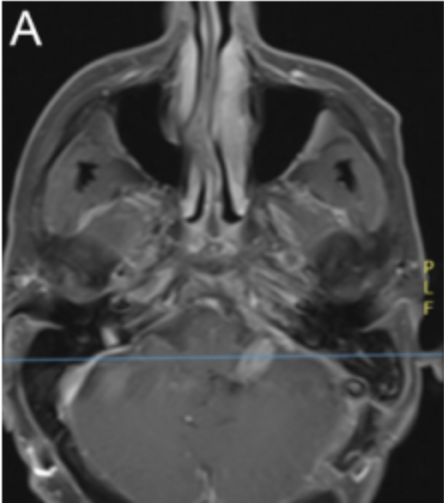






Tremor in MS results from demyelinating lesions affecting cerebellothalamic pathways, making treatment challenging. Pharmacological management often has limited efficacy, while neurosurgical approaches have emerged as viable strategies. Diffusion tensor imaging (DTI)-based tractography enables precise identification of the DRT, optimizing targeting accuracy and clinical outcomes.
Objective
To present a case of kinetic-postural tremor secondary to multiple sclerosis (MS) successfully treated with tractography-guided thermal ablation of the left dentatorubrothalamic tract (DRT) in the ventral intermediate (VIM) thalamic nucleus, demonstrating significant functional improvement.
Method
A 49-year-old right-handed female with primary progressive MS presented with a right-sided kinetic-postural tremor that worsened over time. Pharmacological treatments failed to provide significant relief. She scored 51 points on the Fahn Tremor Assessment Scale (FTM). A stereotactic thermal ablation of the left VIM was performed, focusing on the DRT intersection, with intraoperative electrophysiological confirmation to optimize lesioning for maximal tremor control while preserving surrounding structures.
Results
The procedure led to an 80% tremor reduction, significantly improving quality of life. No new neurological deficits were observed, and tremor reduction remained stable in follow-ups. Unlike deep brain stimulation (DBS), this ablative approach permits unrestricted future MRI studies, ensuring optimal disease monitoring.
Conclusion
This case underscores the efficacy of tractography-guided thermal ablation of the DRT-VIM intersection for MS-related tremor. Compared with alternative approaches such as focused ultrasound and gamma knife radiosurgery, thermal ablation offers a balance of precision, immediate efficacy, and accessibility. Unlike Parkinson’s disease, MS tremor occurs within a demyelinating context, requiring long-term imaging follow-up. Ablative procedures facilitate continuous disease surveillance without MRI restrictions. Given the refractory nature of MS tremor and its impact on quality of life, this case reinforces ablative treatments as effective long-term options. Potential risks include lesion extension causing unintended neurological deficits, and durability of tremor control remains an area for further research.
Suggested citation
F. Fenner, E. da Silva, W. Morikawa, E. Gisoldi, A. Venturi, G. Chung. MS-Related Tremor in a Patient with Multiple Sclerosis Treated with Thermal Ablation of the Left Ventral Intermediate (VIM) Thalamic Nucleus: The Role of Tractography-Guided Targeting [abstract]. Mov Disord. 2025;40(Suppl 1).
Authors: F. Fenner, E. da Silva, W. Morikawa, E. Gisoldi, A. Venturi, G. Chung (Sao Paulo, Brazil)
Meeting: 2025 International Congress
Category: Tremor
Keywords: Multiple sclerosis (MS), thalamotomy, tremors: treatment